
Manal Saleh
· Hyundai Motor reinforces its target of 5.55 million global vehicle sales by 2030
…
Electrified vehicles to reach 3.3
million units by 2030, including 18+ hybrid models and comprehensive EV lineup
…
Expanding into new segments, including
mid-size pickup trucks and light commercial vehicles
…
All-new regional EVs: IONIQ 3 for
Europe, India's first locally designed EV, and China-produced Elexio and electric
sedan
…
First Extended Range EV (EREV) models to
launch from 2027, bridging the transition to full electrification with more
than 600-mile driving range
·
Phase 2 HMGMA expansion adds production
capacity of 200,000 units by 2028, with $2.7 billion investment creating 3,000
new jobs
…
Global manufacturing expansion
integrating Software-Defined Factory targets 1.2 million additional units
across its manufacturing facilities worldwide
·
Next-generation battery technology to
achieve cost and performance improvements, including cloud-based battery
management system from 2026
·
Software-Defined Vehicle (SDV) platform
transforms customer experience
…
Powered by High-Performance Vehicle
Computer architecture, enabling continuous updates, personalized features and
AI-driven mobility services
·
Genesis luxury brand to introduce EREV,
hybrid and BEV powertrains across complete lineup, including its flagship SUV,
targeting annual sales of 350,000 units by 2030
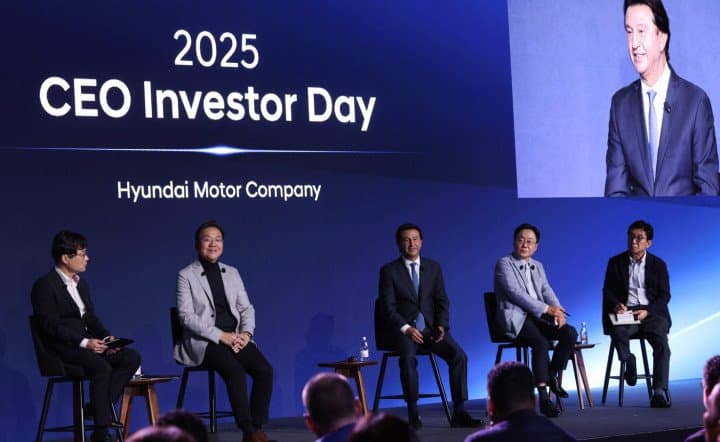
Dubai, United Arab Emirates, September
19, 2025 – Hyundai Motor Company unveiled its most
ambitious growth strategy today at the company’s first CEO Investor Day held
outside of Korea.
The event served as a platform to communicate
the company’s mid-to long-term strategy to investors and stakeholders,
emphasizing its commitment to revolutionary product expansion, manufacturing
excellence and technological innovation.
Speaking in New York, CEO José Muñoz outlined
Hyundai Motor's transformation into a global mobility leader through strategic
product expansion, breakthrough electrification technologies and
software-defined capabilities that will redefine the automotive experience.
"In an industry facing unprecedented
transformation, Hyundai is uniquely positioned to win through our unmatched
combination of compelling products, manufacturing flexibility, technology
leadership, outstanding dealer partners and global scale,” said José Muñoz,
President and CEO of Hyundai Motor Company. “We are delivering comprehensive
electrified portfolios across all segments, localizing production in key
markets, and leveraging breakthrough technologies from Software-Defined
Vehicles to next-generation batteries. Our ability to adapt quickly, combined
with the power of Hyundai Motor Group's 50+ affiliates and our unwavering
commitment to customers, will enable us to continue unlocking tremendous value
for our stakeholders. It's a great time to be with Hyundai.”
Hyundai Motor reaffirms its commitment to
achieving 5.55 million global vehicle sales by 2030. Building on this momentum,
electrified vehicles are expected to account for 60 percent of total sales,
reaching 3.3 million units, with significant growth anticipated in North
America, Europe and Korea.
Revolutionary Product Portfolio Expansion
The
company will expand its hybrid lineup to more than 18 models by 2030, including
the introduction of Genesis hybrid models starting from 2026. The All-New
Hyundai Palisade Hybrid will also showcase next-generation TMED-II technology,
offering enhanced performance and fuel efficiency.
Hyundai
Motor will launch its first mid-size pickup truck before 2030 in North America,
targeting one of the largest segments in the industry. Since launching the
Santa Cruz in 2021, the company has gained valuable experience and brand
presence, positioning it strongly to broaden its reach in the heart of the U.S.
market.
Hyundai
Motor's EV strategy features regionally tailored products designed for specific
markets.
The
IONIQ 3 will highlight Hyundai Motor’s aim to target European mass-market
customers with next-generation infotainment systems. India will receive the
country's first EV designed specifically for local drivers, while the market
will also benefit from a localized supply chain. China gets the locally
produced Elexio SUV and C-segment electric sedan, marking a major milestone in
Hyundai Motor's Chinese market commitment.
These
additions will complement the existing EV lineup – including IONIQ 5, IONIQ 6
and IONIQ 9 – providing a full spectrum of options for consumers across diverse
markets.
Launching
in 2027, Extended Range EVs (EREVs) will utilize high-performance batteries and
motors to deliver EV-like driving experiences with more than 600 miles (960km)
of range through optimized battery-engine integration.
Unlike
conventional EREVs, Hyundai’s approach utilizes in-house high-performance
batteries, achieving full EV power performance with less than half the battery
capacity, improving accessibility while maintaining exceptional range and
performance, and eliminating range anxiety.
The
high-performance N lineup will expand to more than seven models by 2030,
targeting over 100,000 global sales. The All-New IONIQ 6 N will introduce a new
paradigm for high-performance EVs, featuring three temperature optimization
modes and signature N sensory engagement technologies.
In the
commercial vehicle segment, Hyundai Motor will expand its portfolio in the
North American market. This includes existing XCIENT Fuel Cell Trucks and
Hyundai Translead trailers, along with plans to enter the electrified large van
market. These offerings will leverage the company’s existing commercial vehicle
production hubs to support sustainable logistics solutions.
Global Manufacturing Innovation with
Software-Defined Factory
As part of Hyundai Motor Group’s investment
plan announced in August, Hyundai Motor Group Metaplant America (HMGMA) is set
to reach a total production capacity of 500,000 units by 2028, focusing on
hybrid and electric vehicles. This expansion will create 3,000 direct and
indirect jobs in Georgia and involve a USD 2.7 billion investment over three
years.
Hyundai Motor aims to produce more than 80
percent of vehicles sold in the United States domestically by 2030, with supply
chain content increasing from 60 percent to 80 percent.
Globally, the company plans to accelerate its
production capacity by adding 1.2 million units by 2030. This includes 500,000
additional units from HMGMA, 250,000 units from the Pune multi-model export hub
in India, and 200,000 units from the dedicated EV plant in Ulsan.
In addition, CKD sites in Saudi Arabia,
Vietnam, North Africa and other countries are expected to contribute another
250,000 units. Notably, the Saudi Arabia plant, scheduled to begin operations
in the fourth quarter of 2026, will feature next-generation robotics and
localized manufacturing under the “Saudi Made” initiative, with a production
capacity of 50,000 units.
Manufacturing excellence extends beyond
volume increases through comprehensive Software-Defined Factory implementation.
Hyundai Motor Group Innovation Center Singapore (HMGICS) continues cascading
breakthrough technologies to global plants, achieving measurable improvements
in production flexibility.
HMGMA is expected to produce a mix of 10
hybrid and EV models, while the new Ulsan EV plant will manufacture up to 12 EV
models through advanced robot-based automation systems enabling predictive
maintenance, digital simulation and self-diagnostics.
Boston Dynamics integration advances core
robotics technologies, enhancing operational excellence through intelligent
automation and human-robot collaboration. This extends beyond manufacturing to
logistics, smart infrastructure and future mobility applications.
Advanced Technology Acceleration
Battery innovation remains a core focus for
Hyundai Motor. The company continues to enhance battery durability, cost
efficiency and safety through a customer-centric design philosophy. These
advancements underscore the company’s leadership in battery technology and its
commitment to delivering reliable and safe electrified vehicles.
Hyundai Motor's battery strategy delivers
industry-leading improvements by 2027: 30 percent cost reduction, 15 percent
higher energy density and 15 percent shorter charging times, dramatically
strengthening EV competitiveness. The company has analyzed durability data from
over 50,000 IONIQ 5 vehicles, including units driven more than 250,000 miles
(400,000km), showing most vehicles retain more than 90 percent battery
performance.
Advanced safety technologies include
industry-leading Battery Management Systems (BMS) performing real-time
predictive diagnostics during driving, charging and rest periods. From 2026,
cloud-based BMS will collect data from diverse vehicle environments, applying
proprietary advanced modeling for faster, more precise diagnostics. Multiple
exclusive safety layers include separation barriers, ultra-safety relays,
refractory shields and safety vents preventing thermal runaway and safeguarding
against fires.
Hyundai Motor also leads the industry in fuel
cell technology, with 73,000 cumulative fuel cell electric vehicle sales. The
company is developing next-generation fuel cell systems for
commercial-exclusive applications, offering high efficiency, durability and
power output to meet the demands of future mobility.
Hyundai Motor is accelerating its transition
to Software-Defined Vehicles (SDVs) through a comprehensive technology stack
centered on Computing & Input/Output domain-based E&E architecture
(CODA), a simplified hardware architecture that separates software from
hardware to maximize development efficiency and scalability. This structure is
supported by the High-Performance Vehicle Computer (HPVC) and zone controllers,
which reduce wiring complexity and eliminate the need for additional hardware
controllers.
At the core of the company’s SDV strategy is
Pleos, an in-vehicle distributed operating system that enables rapid software
updates, personalized feature enhancements and a safer, more flexible driving
experience. With hardware and software separated, Pleos provides a highly
flexible plug-and-play environment that supports diverse hardware solutions and
accelerates the implementation of security and feature updates.
Hyundai Motor will begin rolling out Pleos
Connect, its next-generation infotainment system, starting in the second
quarter next year. Key features include multi-window functionality, user
profile-based personalization and an in-vehicle marketplace for third-party
apps, creating new service-based revenue opportunities.
AI technologies also play a critical role in
Hyundai Motor’s SDV vision. Atria AI enables autonomous driving without
detailed maps, Gleo AI offers intuitive voice-based interaction and Capora AI
enhances fleet management through large-scale data analysis.
Genesis Luxury Transformation
Genesis, Hyundai Motor’s luxury brand, is
celebrating its 10th anniversary with remarkable achievements. The brand has
reached one million cumulative sales in less than eight years and maintains
double-digit profit margins across more than 20 global markets, solidifying its
position as a top-tier premium automotive brand.
Genesis aims to reach 350,000 annual sales by
2030, expanding its presence in the United States, Europe, the Middle East,
Korea, China and emerging markets. The brand’s product vision includes luxury
SUVs such as the X Gran Equator and Neolun concepts, emotional halo models like
the X Gran Coupe Concept, and Magma Halo and ultra-bespoke vehicles elevating
its luxury positioning.
Genesis Magma Racing will debut in the FIA
World Endurance Championship in 2026 and IMSA SportsCar Championship in 2027,
channeling racing technology breakthroughs into the complete Genesis portfolio.
The brand aims to expand its presence in up to
20 European markets while strengthening core market presence through U.S.-based
production and EREV launches. The next-generation platform supports
multi-energy configurations and SDV intelligence via CODA architecture, while
preserving the brand’s DNA of solid and agile driving characteristics.
Strategic Partnership Ecosystem
Hyundai Motor is accelerating market
penetration and technology development by transformative alliances.
The collaboration with Waymo includes IONIQ 5
prototypes which have completed inspection and been delivered for public road
testing in the U.S. this year. These vehicles feature Waymo’s fully autonomous
driving technology, marking a significant milestone in Hyundai Motor’s
autonomous mobility strategy.
A strategic alliance with General Motors
includes five co-developed vehicles launching as early as 2028. Hyundai Motor
expects annual sales of these models to exceed 800,000 units once production is
fully scaled.
The lineup includes electric commercial vans
for the North American market, as well as compact vehicles, compact SUVs and
compact and midsize trucks for Central and South America, leveraging GM’s
expertise and Hyundai Motor’s manufacturing capabilities.
Hyundai Motor’s partnership with Amazon Autos
is enhancing brand awareness, boosting sales conversion and leveraging Amazon’s
high customer satisfaction to reach new audiences.
The collaboration also improves dealer
profitability through new financing options, accessory offerings and enhanced
offline sales visibility. This initiative supports the company’s goal of
modernizing the customer journey and expanding its presence in the online
automotive marketplace.
Financial Projections and Shareholder Value
At the event, Hyundai Motor’s CFO, Seung Jo
(Scott) Lee, outlined the company’s financial strategies. He announced Hyundai
Motor’s annual guidance update, future investment plan, mid-to long-term
financial target, and shareholder return policy.
Target revenue has been revised upward by 5–6
percent, reflecting an increase of two percentage points from the January
announcement. The company adjusted its operating profit margin (OPM) target to
6–7 percent, down one percentage point, citing the impact of newly imposed U.S.
tariffs.
Hyundai Motor announced a KRW 77.3 trillion
investment plan over five years from 2026 to 2030, up KRW 7 trillion from last
year’s guidance. The investment breakdown includes KRW 30.9 trillion for
Research and Development (R&D), KRW 38.3 trillion for Capital Expenditure
(CAPEX), and KRW 8.1 trillion for strategic investments.
This investment aims to strengthen global
competitiveness through the development of software talent, expansion of
localized capacity, and investment in strategic areas, including future
technologies.
To accelerate localization and improve
profitability, the company will invest KRW 15.3 trillion to expand production
capacity and establish a robotics ecosystem in the United States, as part of Hyundai Motor Group’s broader USD 26 billion commitment in the
U.S.
Hyundai Motor aims to achieve a sustainable
operating profit margin of 7–8 percent by 2027 and 8–9 percent by 2030 through
an improved product mix — including hybrid and Genesis models — localization
strategy, and enhanced cost efficiency.
From 2025 to 2027, Hyundai Motor will
implement a Total Shareholder Return (TSR) policy of over 35 percent, as
announced at last year’s CEO Investor Day. This will be achieved through a
flexible combination of dividends, share buybacks, and treasury stock
cancellations. The company will also maintain a minimum Dividend Per Share
(DPS) of KRW 10,000.
"We're not just adapting to change –
we're leading it," Muñoz concluded. "Through our commitment to
electrification, our investment in software-defined vehicles, our focus on
manufacturing excellence, and our dedication to treating every customer like an
honored guest, we're building the mobility company of the future."
###
About
Hyundai Motor Company
Established in
1967, Hyundai Motor Company is present in over 200 countries with more than
120,000 employees dedicated to tackling real-world mobility challenges around
the globe. Based on the brand vision ‘Progress for Humanity,’ Hyundai Motor is
accelerating its transformation into a Smart Mobility Solution Provider. The
company invests in advanced technologies such as robotics and Advanced Air
Mobility (AAM) to bring about revolutionary mobility solutions while pursuing
open innovation to introduce future mobility services. In pursuit of a
sustainable future for the world, Hyundai will continue its efforts to
introduce zero-emission vehicles with industry-leading hydrogen fuel cell and
EV technologies.
More information
about Hyundai Motor and its products can be found at: or Newsroom: Media Hub by Hyundai
-large.jpg)


-large.jpg)



كن أول من يشارك رأيه
ابدأ النقاش حول هذه القصة.