
Manal Saleh
Since
introducing the first Galaxy
Fold at 276 grams in 2019, Samsung Electronics has continued to
expand what a foldable smartphone can be, advancing hinge and display design,
durability and usability with every generation.
As those technologies evolved,
Samsung focused on another challenge: making
a large-screen foldable easier to carry every day, without losing the
experiences that make the form factor unique.
And through that pursuit, Galaxy Z Fold5 weighed 253 grams, and Galaxy Z Fold6 reduced its
weight further to 239 grams.
With Galaxy Z Fold7 came an even
more ambitious goal:
“Could a foldable be lighter than a bar-type
flagship smartphone?”
At the time,
Galaxy S25 Ultra — one of Samsung’s flagship bar-type smartphones — weighed 218 grams. So, the
development team set an even lighter weight target for Galaxy Z Fold7: 215 grams.
Galaxy Z Fold7 reached that
goal. And now, building on years of foldable innovation, Galaxy Z Fold8
combines a new form factor with advances in core technologies, materials and
internal architecture to weigh just 201 grams — 52 grams lighter than Galaxy
Z Fold5. At 201 grams, Galaxy Z Fold8 is the world’s lightest fold.[1]

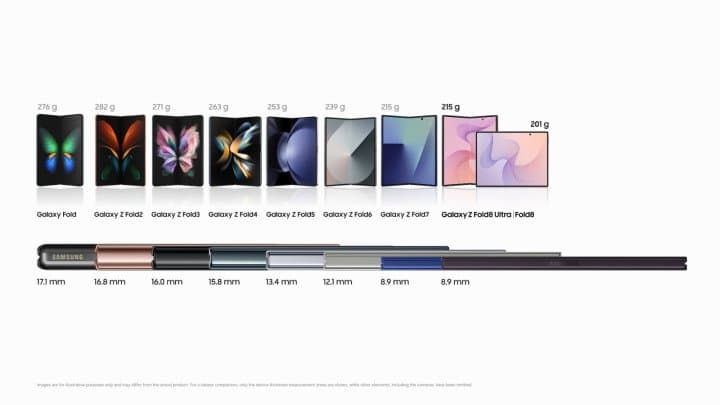
Galaxy Z Fold’s weight and
thickness evolution by generation, from 276 grams and 17.1 millimeters with the
first Galaxy Fold to Galaxy Z Fold8 at 201 grams and 9.7 millimeters, the
world’s lightest foldable, alongside Galaxy Z Fold8 Ultra at 8.9 millimeters
thick.
But consumers expected more
than just a lighter foldable.
A 2024
YouGov survey[2] found
that a bulky or heavy design remained a concern among consumers not
planning to purchase foldables, while battery life, durability and display
quality ranked as top priorities for those considering them.
This insight shaped a core
engineering goal for Samsung: make
foldables thinner and lighter, while maintaining the core experiences users
value most.
Battery life, camera
performance, thermal management and durability still had to advance.
That could not be achieved by
changing a single component. Samsung engineers had to reimagine the entire device
— advancing fundamental foldable
technologies, introducing new materials and revisiting hundreds of components
and auxiliary parts to the fraction-of-a-gram level.
From 253 grams to 201 grams. Three
engineering innovations enabled that transformation.
From
Galaxy Z Fold5 to Galaxy Z Fold8, Samsung reduced 52 grams to deliver the
world's lightest foldable.
The Thinner and Lighter a
Foldable Gets, the More Precise the Engineering Must Become
Making a foldable thinner and
lighter brings a new set of engineering challenges.
The layers inside the display
need to become thinner while still meeting Samsung’s durability and reliability
requirements. The metal plate supporting the display needs to stay extremely
flat even as it becomes thinner. And the hinge has to manage the forces created
every time the device folds and unfolds, while being designed around the size
and structure of each product.
Across generations, Samsung
has continued to advance the display
layers, ultra-thin metal precision machining and hinge technologies
central to its foldable devices.
One example is Flex
Titanium.
The displays in Galaxy Z Fold8
and Galaxy Z Fold8 Ultra use Flex Titanium technology featuring a Titanium Alloy Film designed
for the foldable display structure.
The film is just tens of micrometers thick — roughly
one-third the width of a human hair. Its material and structure
work together to maintain performance at this extreme thickness.
The metal plate that supports
the display presents a different challenge.
Some metal plates are machined
to approximately 0.2 millimeters thick, with the thinnest sections
reaching 0.15 millimeters. At that level, simply making the metal
thinner is not enough. Thin metal can bend or warp more easily during
machining, and even a small change in shape can affect assembly precision or
the surface quality of the display.
What matters is the ability to
machine ultra-thin metal
at around 0.2 millimeters while consistently achieving the required shape and
flatness.
Samsung refined the machining
sequence, tooling, cooling conditions and process parameters, breaking the
process into multiple stages to maintain precision.
The hinge requires the same
level of care.
Beyond simply opening and closing
the phone, it must distribute the forces created by repeated folding and
unfolding across the device while maintaining structural stability.
And these requirements vary by
product size and architecture.
Samsung engineers the hinge
for each form factor, carefully balancing load distribution, strength, durability, internal space and
weight rather than just scaling it down from one generation to
the next.
Creating a thinner and lighter
foldable requires more than downsizing individual parts.
It comes from greater precision in how materials are
machined, how forces are managed and how structures are designed within a
limited space.
Lighter, Built for Strength —
Starting With the Materials
The second area is materials innovation.
Different parts of a foldable
have very different jobs. Some demand high rigidity. Some must withstand
repeated movement. Others need to spread heat efficiently.
Samsung selects and develops
materials around those specific needs, delivering the performance each requires
while optimizing weight and space.
In Galaxy Z Fold8 and Galaxy Z
Fold8 Ultra, Flex Titanium
incorporates a Titanium
Alloy Film to support the foldable display structure.
For the exterior, Samsung uses
Advanced Armor Aluminum,
helping provide the strength and durability needed in a thin and lightweight
frame.
Materials also play an
important role in thermal management.
As a device gets thinner,
there is less room to manage the heat generated inside. Samsung uses graphite with improved thermal
performance, while tailoring the overall thermal structure to
the size and performance requirements of each product.
In Galaxy Z Fold8 Ultra, which
has similar overall dimensions to Galaxy Z Fold7, the volume of the graphite heat-dissipation layer was
increased by approximately 7% to help support its enhanced
performance.
Samsung also applies Clad Metal inside the
rear of the device. By combining the characteristics of different metals, the
material helps reduce weight while providing the thermal performance required
within a thin structure.
Materials innovation is
therefore not just about choosing lighter options, but about using the right material in the right
place to deliver the performance each part needs with less weight and space.
Looking Again at the Entire
Device — Down to 0.001 Grams
Only so much can be achieved
through core technologies and new materials alone.
In a foldable already packed
with highly integrated components, finding the next few grams means looking again at almost everything
inside the device.
Samsung engineers reviewed
approximately 270
components and more than 180 types of auxiliary parts.
This spanned everything from the
display, hinge and cameras to circuit boards, antennas, brackets, tapes and
fasteners.
The precision extended to
reductions of 0.1 grams and 0.1 millimeters, and in some auxiliary parts, as little as 0.001 grams.
The printed circuit board, or
PCB, was redesigned to remove unnecessary circuits, improve component layout
and minimize its footprint.
The MFC (Magnetic Flux Channel) antenna
was also reimagined to reduce unnecessary overlap and interference with
surrounding components, allowing the limited internal space to be used more
efficiently.
Every auxiliary part, no
matter how small, was examined.
Of the more than 180 types
previously used, approximately
15 were eliminated.
Engineers then reviewed the
remaining 170 types, trimming
oversized areas, refining shapes and optimizing dimensions. Multiple parts were
consolidated into single structures where possible.
In some cases, the savings
were measured in increments as small as 0.001
grams.
Each change seems minor in
isolation, but repeated across the device, fractions of a gram become tenths of
a gram, then whole grams.
The weight savings on a finished device result
from hundreds of small engineering decisions.
Finding 6 Grams Again to Make
Room for More
The goal was to reinvest
the weight and space recovered through engineering into the capabilities people
actually experience — including the battery, cameras and thermal system.
Galaxy Z Fold8 Ultra
provides a separate example of how this approach can be applied.
Galaxy Z Fold8 Ultra
and Galaxy Z Fold7 have similar overall dimensions and both weigh 215 grams.
But within that same weight, Galaxy Z Fold8 Ultra increases battery capacity
from 4,400 mAh to 5,000 mAh.
That larger battery
brought its own challenge: the battery itself added approximately 6 grams.
So the development team
faced a new question:
“Where could we find those 6 grams
again?”
There was no single component
that could provide the answer.
Instead, engineers applied the
same systematic approach across the entire device — materials and structures,
circuit layouts and component placement, down to the smallest auxiliary parts —
identifying weight savings across all components.
This strategy extended to
internal space optimization.
By reducing unnecessary
overlap between the display, circuits, antennas and surrounding components, and
by improving packaging efficiency, Samsung created room for a larger battery
and enhanced thermal and camera systems.
As a result, Galaxy Z Fold8
Ultra accommodates a 5,000
mAh battery while increasing the volume of its graphite heat-dissipation layer by
approximately 7% compared with the similarly sized Galaxy Z Fold7.
Galaxy Z Fold8 Ultra features a
200 MP main camera and introduces the first 50 MP Ultra-Wide camera on a
Galaxy Z Fold device.
Samsung's approach to a
thinner and lighter foldable is therefore not about removing capabilities.
It is about redirecting weight and space savings
toward the flagship experiences users value most.
From 253 Grams to 201 Grams:
Redefining the Weight Standard for Foldables
The
journey began with the first Galaxy
Fold at 276 grams in 2019. Across eight generations, Samsung
has continued to advance the technologies, materials and internal architecture
behind the foldable experience.
In recent generations, that
progress accelerated — from 253
grams with Galaxy Z Fold5 to 201 grams with Galaxy Z Fold8.
But the story isn’t just about
reducing weight.
Samsung’s goal has been to
make a large-screen foldable easier to carry without giving up the qualities
users expect from a flagship smartphone.
The weight and space recovered
through advances in core technologies, materials and component design were put
back into the battery,
cameras, thermal system and other flagship experiences users value most.
From 253 grams to 201 grams.
No single material or
component made that transformation possible.
Eight
generations of engineering enabled this, advancing core technologies,
introducing new materials and rethinking the entire device to make Galaxy Z
Fold easier to carry without compromising the flagship experience.
Galaxy Z Fold Series: A Thinner, Lighter
Journey in Numbers
[1] Based on internal
research as of July 22, 2026, comparing commercially available book-style
foldable smartphones globally. Exact weight may vary by model, configuration
and manufacturing process. Weight measured excluding protective cases or
accessories.
[2]
Source: YouGov
plc, 2024, © All rights reserved


-large.jpg)





كن أول من يشارك رأيه
ابدأ النقاش حول هذه القصة.