
Rashad Iskandrni
Kia
Supports The Ocean Cleanup's Panama City Plastic
Waste Reduction Initiative under the 30
Cities Program
August, 2026 – Kia Corporation (Kia)’s non-profit partner, The
Ocean Cleanup, is showcasing Panama City as an exciting example of the impact
made possible through its landmark 30 Cities Program, celebrating
measurable success in plastic reduction across urban rivers in the region.
On July 7-8, an
international team of partners, media and other stakeholders travelled to the
region to witness the project’s effects firsthand, interview those who are both
implementing and benefiting from it on the ground and record its impact on the
local environment. A documentary video from the visit can be viewed here.
The Ocean Cleanup is a global non-profit organization based in the
Netherlands. It develops and scales solutions to rid the oceans of plastic
pollution by both stemming inflow via rivers and removing waste that has
already accumulated.
With the global non-profit already responsible for preventing over
60 million kilograms of trash from reaching the world’s oceans, the 30 Cities
Program aims to scale its Interceptor™ solutions across key population
centers in Asia and the Americas.
The Ocean Cleanup seeks to eliminate up to one third of all
river-borne plastic flowing into the ocean by the end of the decade,
contributing to an eventual 90 percent reduction in floating ocean plastic
pollution worldwide by 2040.
In collaboration with both national government and city
authorities in Panama City, The Ocean Cleanup and local non-profit partner
Marea Verde, alongside local communities, are working towards the successful
restoration of the seven major rivers flowing through Panama City as part of
the ‘Seven Basins’ Project, stopping the flow of trash into the Bay of Panama
using The Ocean Cleanup’s proven Interceptor technology.
The project aims to:
· Prevent
more than 800,000 kilograms of waste from reaching the sea each year.
· Recover
at least 100,000 kilograms of plastic annually.
· Contribute
to a clean ecosystem for more than two million migratory birds.
· Restore
more than 30 km of coastline.
· Improve
quality of life in communities along the intervened rivers.
According to the United
Nations Environment Program, Panama City generates over 41,000 tons of plastic
waste each year. Located on the country’s Pacific coast, the already severe
societal and ecological impact of plastic waste pollution is amplified by the
area’s rich biodiversity and critical ecosystems, including mangroves.
As part of a strategic
alliance with Marea Verde, the installation of The Ocean Cleanup’s
Interceptor 022 on the Río Abajo and Interceptor 025 on the Río Matías
Hernández are now delivering measurable, city-wide results in plastic waste
reduction.
In addition to
initiatives planned for a further five regional waterways, and the
implementation of environmental education programs to reduce the creation of
plastic waste at source, it is hoped that the project’s impact will continue to
scale exponentially.
Steve Lee, President of Kia Central & South America regional
headquarters, said: “Kia's partnership with The Ocean Cleanup demonstrates our
commitment to environmental stewardship. Panama City exemplifies how
innovation, collaboration, and corporate responsibility can protect our oceans
and preserve biodiversity. We're proud to support this transformative work and
look forward to expanding it across the region.”
James Patterson, Panama Lead at The Ocean Cleanup, added: “With
the support of Kia, our work in Panama is a powerful example of how global
expertise and local commitment can come together to provide solutions that
protect vital ecosystems. By combining innovative technology with on-the-ground
knowledge, we’re not just stopping plastic at its source—we’re creating a
blueprint for cleaner, healthier cities and oceans.”
Kia Corporation and The Ocean Cleanup are in the midst of a
long-term partnership that began in 2022 and will continue until 2031. As a
Global Mission Partner, Kia provides funding, mobility solutions and R&D
expertise to support the non-profit’s operations, while also integrating ocean
plastic harvested by The Ocean Cleanup into its value chain.
The first proof point of this collaboration is the limited-edition
trunk liner for the Kia EV3 made using 40% recycled plastic from the Great
Pacific Garbage Patch, 35% TPV and 25% inorganics or other additives that is
scheduled to go on sale in select European markets later this year.
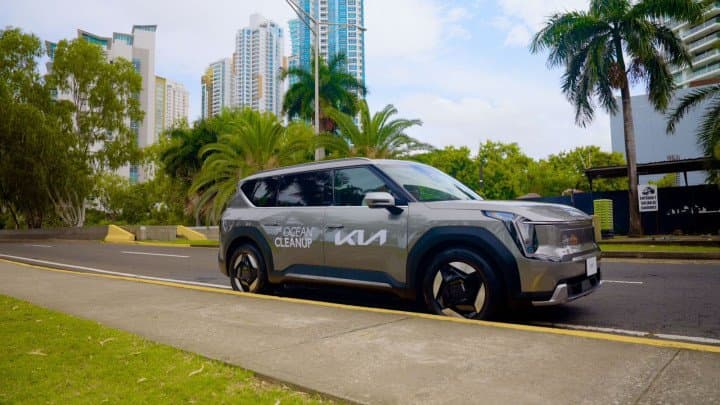
The brand also recently renewed the electric vehicle fleet it
provides to The Ocean Cleanup with the supply of two EV3 and two EV4 models to
assist on-ground operations at its headquarters in Rotterdam, the Netherlands.


-large.jpg)


كن أول من يشارك رأيه
ابدأ النقاش حول هذه القصة.